Tag Archives: neurology

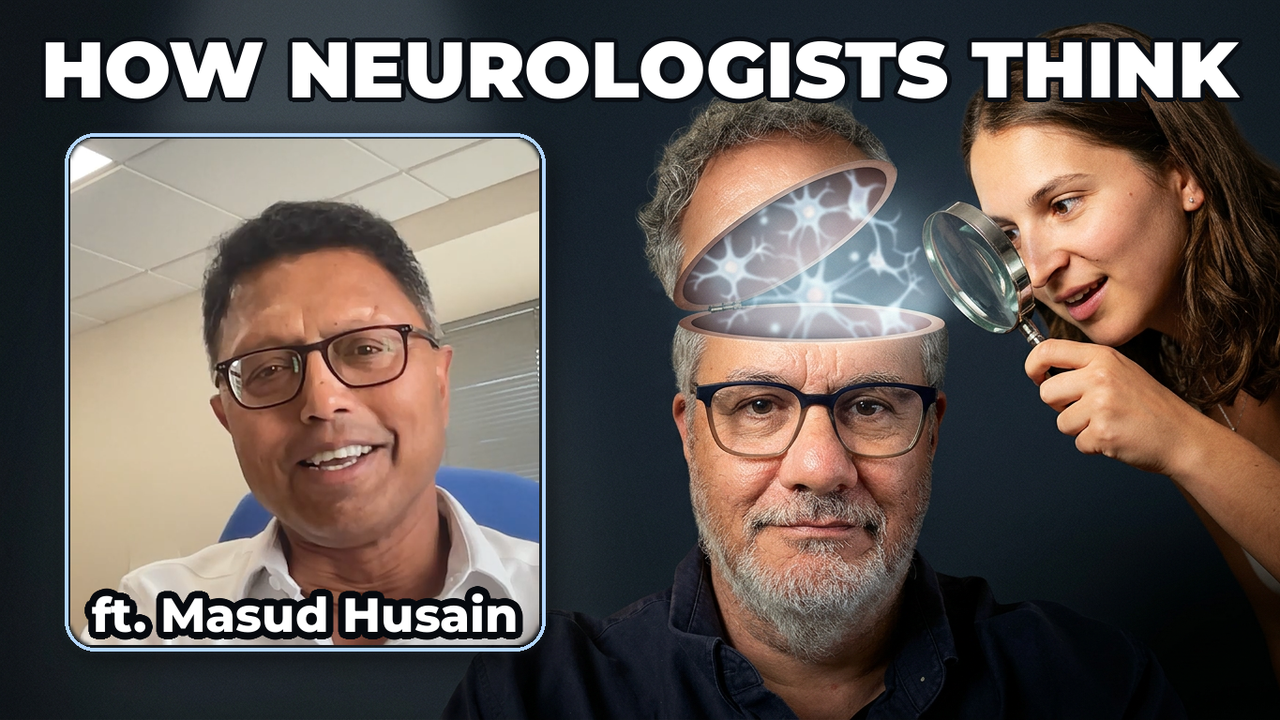
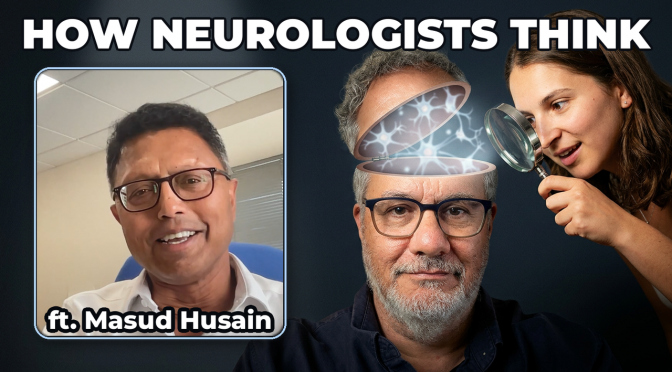
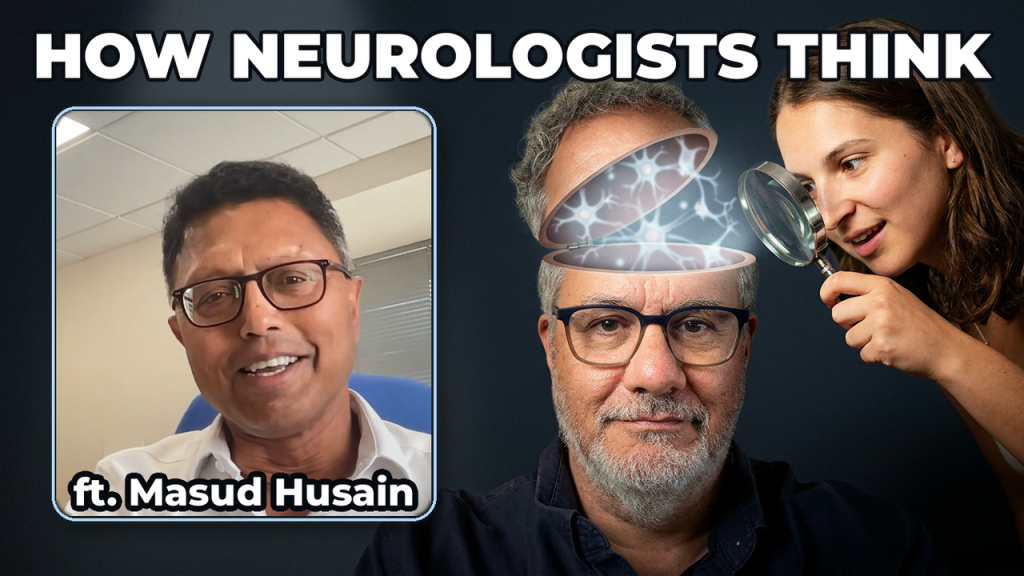
How A Neurologist Thinks about The Self, ft. Masud Husain

Oxford neurologist reveals how small brain changes can rewrite who we are

Dave’s got a brain — he’s pretty sure, anyway, since the MRI never mentioned otherwise — and this week he, with M3 Gizzy Lundquist and M2s Akshaj Joshi and Isa Perez-Sandi sit down with University of Oxford neurologist Masud Husain to talk about what happens when that brain stops working the way it’s supposed to. Husain’s new book, Our Brains, Ourselves: What a Neurologist’s Patients Taught Him About the Brain, walks through seven patients whose identities came apart when a single cognitive process — memory, language, attention, motivation — went sideways, and the crew digs into David, a young finance guy with two tiny basal ganglia strokes who became so profoundly apathetic he couldn’t be bothered to shower, get his Social Security benefits, or put on the music he loved, until a Parkinson’s drug brought him back: new suit, new haircut, new job, new girlfriend, all from restoring one chemical pathway.

Husain almost named the book Outsiders, until his editor worried the parallel between “outsider through brain damage” and “outsider through migration” was too politically loaded to sell, but it’s a parallel that traces straight back to Husain’s own childhood, recording himself on his dad’s reel-to-reel to practice sounding more BBC and less like a kid who’d just moved from the Indian subcontinent. Isa and Akshaj push him on the biology of motivation itself: an Oxford scanner study found apathetic students show more basal ganglia and frontal lobe activity than motivated ones when weighing a reward, not less, because deciding whether something’s worth the effort turns out to be the expensive part. Husain is blunt about the dopamine-detox mythology built around doom scrolling. The evidence, he says, is thin; and he’s just as forthright about where psychiatry and neurology actually diverge: not by nature, but by which one currently has biomarkers, as illustrated by NMDA receptor encephalitis, a condition that looks exactly like schizophrenia until someone finds the tumor causing it.

Also, hemispatial neglect, Lewy body hallucinations, the Bayesian prediction machine your brain runs every time you mistake a shadow for your spouse, and Akshaj corners Husain on the hard problem of consciousness with a theory involving meditators and alpha-wave synchronization. None of them solve it. Good hour of trying, though.
Episode credits:

  • Producer: Dave Etler
  • Co-hosts: Isa Perez-Sandi, Akshaj Joshi, Gizzy Lundquist
  • Guest: Masud Husain
  • Production: SCP Media Lab–Anna Royer, Cyrus Barati, Isa Perez-Sandi, Zach Grissom, Sarah Upton, Srishti Mathur, David Lee, and Jacob Thompson 

The views and opinions expressed on this podcast belong solely to the individuals who share them. They do not represent the positions of the University of Iowa, the Carver College of Medicine, or the State of Iowa. All discussions are intended for entertainment purposes only and should not be taken as professional, legal, financial, or medical advice. Nothing said on this podcast should be used to diagnose, treat, or prevent any medical condition. Always seek qualified professional guidance for personal decisions.

We Want to Hear From You: YOUR VOICE MATTERS!

We welcome your feedback, listener questions, and shower thoughts. Do you agree or disagree with something we said today? Did you hear something really helpful? Can we answer a question for you? Are we delivering a podcast you want to keep listening to? Let us know at https://theshortcoat.com/tellus and we’ll put your message in a future episode. Or email theshortcoats@gmail.com.

We need to know more about you! https://surveys.blubrry.com/theshortcoat (email a screenshot of the confirmation screen to theshortcoats@gmail.com with your mailing address and Dave will mail you a thank you package!)

The Short Coat Podcast is FeedSpot’s Top Iowa Student Podcast, and its Top Iowa Medical Podcast!  Thanks for listening!

Continue reading How A Neurologist Thinks about The Self, ft. Masud Husain
Share

Brains Learning About Brains

Consciousness remains a final frontier of neuroscience and psychiatry…and even immunology

  • M2s Trent Gilbert, Olivia Jenks, PA1 Faith Anton, and M4 Sarah Costello discuss what it might mean that doctors recently discovered a group of patients, previously diagnosed with schizophrenia, who might actually have other treatable immunological disorders that present as psych disorders.
  • We also discuss a new world record kidney stone, medical refugees legislation and healthcare discrimination right here in the US, and an eating disorders chatbot that dispenses terrible advice to people with eating disorders.
  • And, Dave subjects his co-hosts to a pop news pop quiz.

Mentioned:

We Want to Hear From You: YOUR VOICE MATTERS!

No matter where you fall on any spectrum, we want your thoughts on our show.  Do you agree or disagree with something we said today?  Did you hear something really helpful?  Are we delivering a podcast you want to keep listening to?  We’ll be sure your ideas are heard by all–leave a message at 347-SHORTCT (347-746-7828) and we’ll put your message in a future episode (use *67 to be an “Unknown caller”). We want to know more about you: Take the Listener Survey We do more things on…

Continue reading Brains Learning About Brains
Share

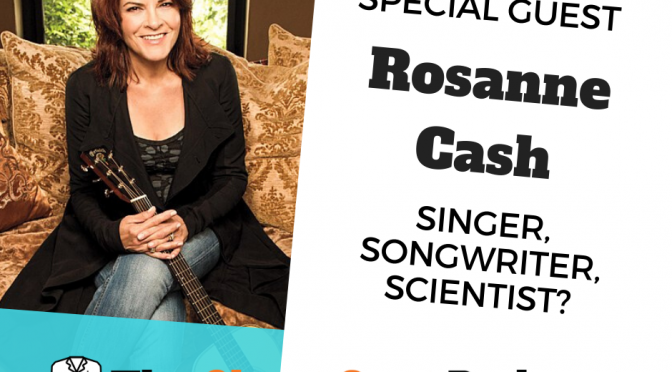
Singer, Songwriter, Scientist: Rosanne Cash

What does Rosanne Cash have to do with science or medicine?

Sure, the American pop, folk, country, and roots rock legend isn’t technically a scientist.  But it was surprising for us to learn that Rosanne Cash has the soul of one within her, with its arms spread comfortably around her musician and poet souls.  When the University of Iowa’s Hancher Auditorium reached out to the College of Medicine to let us know she’d be putting on a concert and might be interested in coming to speak on a panel, we had to dig a little deeper to find out about the connection.

Rosanne was diagnosed in 2007 with Chiari malformation with syringomyelia, a disorder of the skull which puts pressure on the brain and causes the cerebellum to protrude into the spinal canal.  It’s an incredibly painful, debilitating problem that is usually diagnosed in children, not in a woman in her 50s.  Her doctors gave her all sorts of diagnoses (some with a dose of condescension), until she diagnosed herself.  Even then, it took finding the right doctor to believe her to get her on the long journey to recovery.  The lessons of her identity and career-threatening condition are profound.

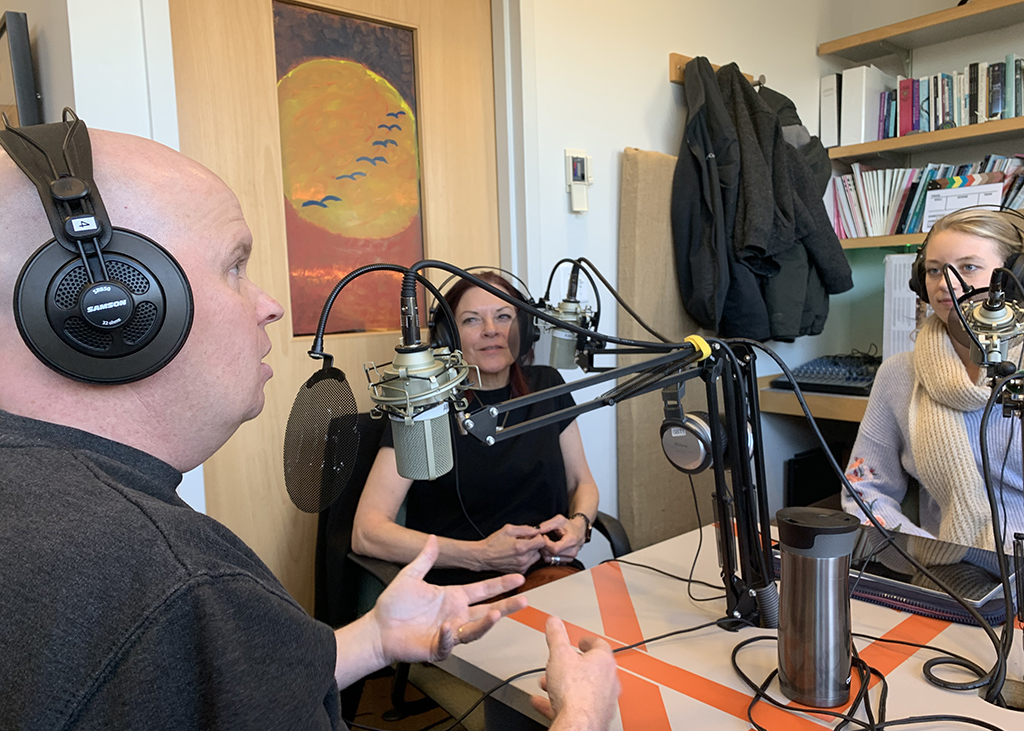
Then, too, there is Rosanne’s curiosity about music and the brain.  With MD/PhD student Miranda Schene, M1 Alexa Schmitz and neuroscientist Justin Sipla, PhD she was fully on board for an often trippy exploration of how and why we are creatures of rhythm, the “sorcery” our brains use to fabricate meaning from vibrations in the world around us, and what an openness to shared experiences can do for medical students and doctors and their patients.

There are other connections to medicine.  The link between a performer being on stage for an audience and physicians performing a role for their patients are considerable, and the lessons Rosanne has learned about creating a shared experience between performer and audience are applicable to the relationship between doctors and their patients.  But there is also her desire to “keep a beginner’s mind” that every doctor should appreciate–cultivating one’s curiosity and understanding that “insecurity is part of the game” are essential lessons that could keep you from missing something important in patient care.


Buy Our Merch and Give At The Same Time

You care about others, or you wouldn’t be into this medicine thing. Our #merchforgood program lets you to give to our charity of the semester and get something for yourself at the same time!

We Want to Hear From You

Never forget that we are always excited to answer our listeners’ questions or take their suggestions. Call us at 347-SHORTCT anytime, or email theshortcoats@gmail.com.

Continue reading Singer, Songwriter, Scientist: Rosanne Cash

Share

Is Your Previous Career A Strike Against You?

Admissions committees care most about what you got out of your experiences, less about what exactly they were.

worried photoHere’s a question we get often, in one form or another: will [some aspect of my life to date] hurt my chances for getting into medical school?  Kyle Kinder, Irisa Mahaparn, Aline Sandouk, and Hanna Van Ert are here to reassure listener Rachel that, despite her background in medical malpractice law, she’s going to be fine…if she can articulate what she took away from that part of her life.
Listener Fifi Trixiebell, who you may recall set off the keto wars of 2018 which ultimately led Dave to declare a moratorium on diet related topics, wrote in to apologize (no need, Fifi), and also point out that Iowa is the most America of the states.  Can the co-hosts discern which other states have achieved total-Murica status based on their rankings for bald eagles, fast food, and astronauts?


Buy Our Merch and Give At The Same Time

You care about others, or you wouldn’t be into this medicine thing. Our #merchforgood program lets you to give to our charity of the semester and get something for yourself at the same time!

This Week in Medical News

The Chinese researcher who claimed that he’d genetically engineered two girl infants may have accidentally (or as Dave speculates, purposefully) made them into super-intelligent, super-stroke-recovering humans.  And researchers my have discovered an entirely new form of neural communication.

We Want to Hear From You

Do you need advice? We give it out, whether it’s related to med school or not? Call in your pleas for help to 347-SHORTCT anytime, visit our Facebook group, or email theshortcoats@gmail.com.

Continue reading Is Your Previous Career A Strike Against You?

Share