[Dave’s out of the office this week, so please enjoy this previously released episode!]
Real answers for your real med school dilemmas.
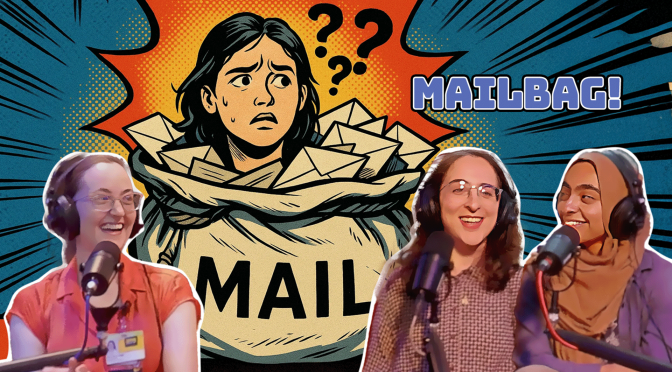
We’ve had some listener question stacking up like it’s the ER waiting room at shift change—and now we’re finally calling some names. This week, we’re clearing the board and giving straight talk on everything from whether Rainey might regret her choice of DNP over med school, Worried Traveler’s fears of surviving their first clinical rotations, and Zion’s untested study habits. You’ll hear why reputation beats job title, the art of asking questions without tanking the vibe, and some ideas on making the transition from an easier undergrad education to med school madness. M4s Hend Al-Kaylani, Maryam Ahmad, and Madeline Ungs confront the awkward task of making friends in med school and why it’s okay if you’re not instantly every resident/faculty favorite.
Bonus web feature! If you fear you never learned to study, visit our this episode’s webpage for a video series by Dave and friends–Zion, this one’s for you!
Episode credits:
Producer: Dave Etler
Co-hosts: Hind Al-Kaylani, Maryam Ahmed, Madeline Ungs\
We Want to Hear From You: YOUR VOICE MATTERS!
We welcome your feedback, listener questions, and shower thoughts. Do you agree or disagree with something we said today? Did you hear something really helpful? Can we answer a question for you? Are we delivering a podcast you want to keep listening to? Let us know at https://theshortcoat.com/tellus and we’ll put your message in a future episode. Or email theshortcoats@gmail.com.
Oxford neurologist reveals how small brain changes can rewrite who we are
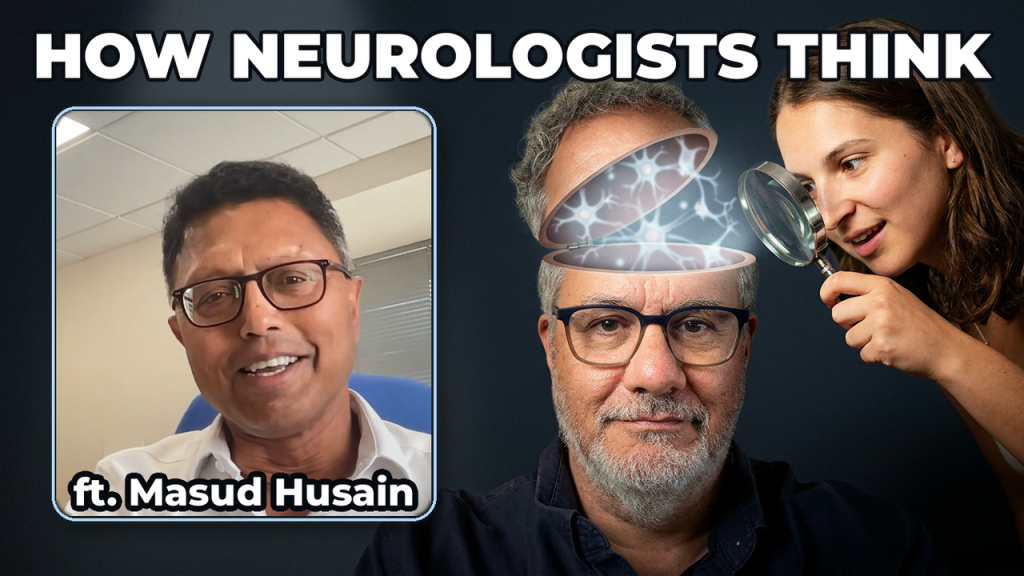
Dave’s got a brain — he’s pretty sure, anyway, since the MRI never mentioned otherwise — and this week he, with M3 Gizzy Lundquist and M2s Akshaj Joshi and Isa Perez-Sandi sit down with University of Oxford neurologist Masud Husain to talk about what happens when that brain stops working the way it’s supposed to. Husain’s new book, Our Brains, Ourselves: What a Neurologist’s Patients Taught Him About the Brain, walks through seven patients whose identities came apart when a single cognitive process — memory, language, attention, motivation — went sideways, and the crew digs into David, a young finance guy with two tiny basal ganglia strokes who became so profoundly apathetic he couldn’t be bothered to shower, get his Social Security benefits, or put on the music he loved, until a Parkinson’s drug brought him back: new suit, new haircut, new job, new girlfriend, all from restoring one chemical pathway.
Husain almost named the book Outsiders, until his editor worried the parallel between “outsider through brain damage” and “outsider through migration” was too politically loaded to sell, but it’s a parallel that traces straight back to Husain’s own childhood, recording himself on his dad’s reel-to-reel to practice sounding more BBC and less like a kid who’d just moved from the Indian subcontinent. Isa and Akshaj push him on the biology of motivation itself: an Oxford scanner study found apathetic students show more basal ganglia and frontal lobe activity than motivated ones when weighing a reward, not less, because deciding whether something’s worth the effort turns out to be the expensive part. Husain is blunt about the dopamine-detox mythology built around doom scrolling. The evidence, he says, is thin; and he’s just as forthright about where psychiatry and neurology actually diverge: not by nature, but by which one currently has biomarkers, as illustrated by NMDA receptor encephalitis, a condition that looks exactly like schizophrenia until someone finds the tumor causing it.
Also, hemispatial neglect, Lewy body hallucinations, the Bayesian prediction machine your brain runs every time you mistake a shadow for your spouse, and Akshaj corners Husain on the hard problem of consciousness with a theory involving meditators and alpha-wave synchronization. None of them solve it. Good hour of trying, though.
Episode credits:
Producer: Dave Etler
Co-hosts: Isa Perez-Sandi, Akshaj Joshi, Gizzy Lundquist
Production: SCP Media Lab–Anna Royer, Cyrus Barati, Isa Perez-Sandi, Zach Grissom, Sarah Upton, Srishti Mathur, David Lee, and Jacob Thompson
The views and opinions expressed on this podcast belong solely to the individuals who share them. They do not represent the positions of the University of Iowa, the Carver College of Medicine, or the State of Iowa. All discussions are intended for entertainment purposes only and should not be taken as professional, legal, financial, or medical advice. Nothing said on this podcast should be used to diagnose, treat, or prevent any medical condition. Always seek qualified professional guidance for personal decisions.
We Want to Hear From You: YOUR VOICE MATTERS!
We welcome your feedback, listener questions, and shower thoughts. Do you agree or disagree with something we said today? Did you hear something really helpful? Can we answer a question for you? Are we delivering a podcast you want to keep listening to? Let us know at https://theshortcoat.com/tellus and we’ll put your message in a future episode. Or email theshortcoats@gmail.com.
[Dave’s out of the office this week, so please enjoy this previously released episode!]
No med student starts with a blank slate
If you’re thinking of starting over and going to med school, you might wonder what your previous jobs have done to prepare you for it. Good news: your old jobs and activities might matter more than your GPA ever will.
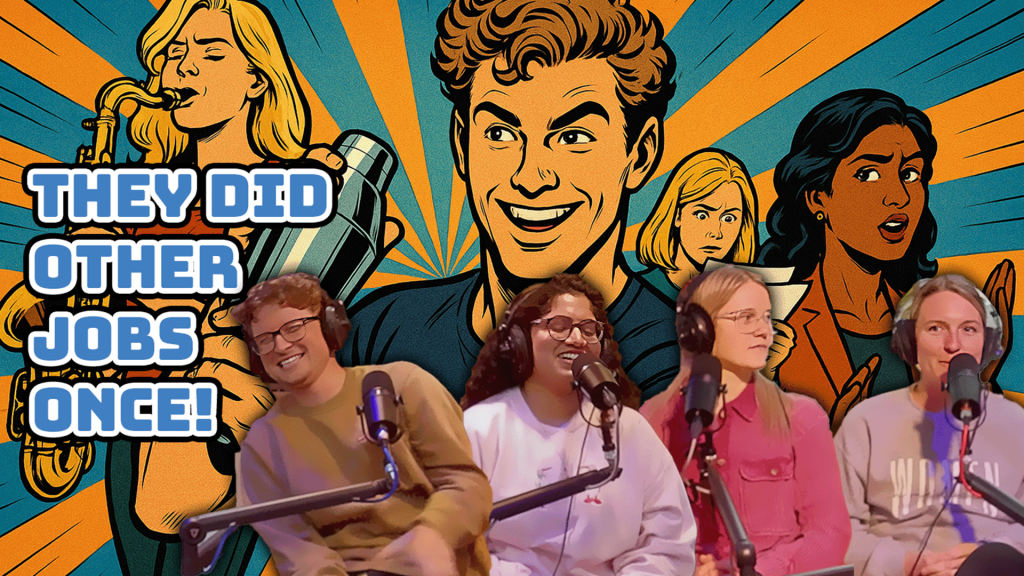
In this episode, M2s Samantha Gardner, Sarah Upton, Nick Lembezeder, and Srishti Mathur unpack the skills they didn’t know they’d use in medicine—the ones they gained by being not-a-doctor. From surviving music juries to calming drunk uncs, from educating bros about consent to making the hard calls without enough information, they’ve found the road to medicine is rarely straight—and that’s probably a good thing.
Also, why confidence is overrated and how to react when given feedback (hint: STFU). Oh, and we hear from a listener who wants to know if we were super studious in high school. We try to let him down gently.
Episode credits:
Producer: Dave Etler
Co-hosts: Srishti Mathur, Nick Lembezeder, Samantha Gardner, Sarah Upton
The views and opinions expressed on this podcast belong solely to the individuals who share them. They do not represent the official positions of the University of Iowa, the Carver College of Medicine, or the State of Iowa. All discussions are intended for entertainment purposes only and should not be taken as professional, legal, financial, or medical advice. Nothing said on this podcast should be used to diagnose, treat, or prevent any medical condition. Always seek qualified professional guidance for personal decisions.
We Want to Hear From You: YOUR VOICE MATTERS!
We welcome your feedback, listener questions, and shower thoughts. Do you agree or disagree with something we said today? Did you hear something really helpful? Can we answer a question for you? Are we delivering a podcast you want to keep listening to? Let us know at https://theshortcoat.com/tellus and we’ll put your message in a future episode. Or email theshortcoats@gmail.com.
Med School Students and Staff Rank Weird Situations
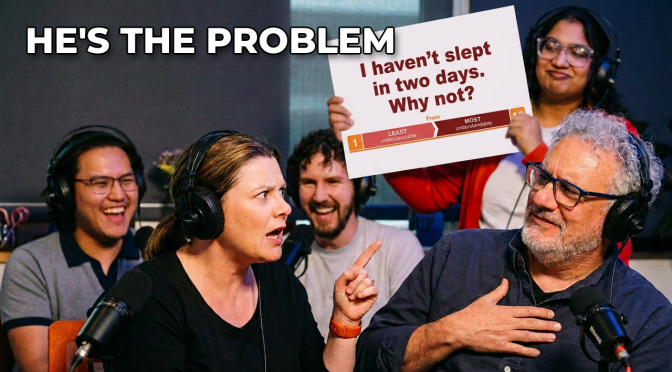
This week M3s Srishti Mathur and Zach Grissom are joined by CCOM admissions expert Rachel Shulista and the PA Program clinicals coordinator Andrew Dao. You might think they’re here to offer their expertise in some informative way so that Short Coat Listeners can benefit. You’d be wrong, because Dave is making everyone rank things nobody should have to rank: how believable your excuse for missing sleep is, how harsh your last piece of attending feedback was, how likely you are to botch a procedure you’ve never done before. It’s another round of our special version of That Escalated Quickly, the card game where the only rule committing to the rank.
Can a very quiet goose gets past MCAT exam security? It’s a question worth knowing the answer to. After all, test day involves tattoo checks and confiscated glasses. We explore how to tell grandma you’re dropping out of med school to make clown shoes. Srishti verifies that Rachel’s forehead isn’t covered in fishing bait before giving it a lil kiss. Rachel, who reads every single admissions application that crosses her desk (but does not make decisions on them, she swears, don’t @her) does not appreciate Dave’s BS and tells him he’s the problem.
Also, we settle the eternal question on how to answer “why do you want to be a doctor” at a party, and Dave does an Obama impression that everybody agrees needs work.
Episode credits:
Producer: Dave Etler
Co-hosts: Srishti Mathur, Zach Grissom, Rachel Shulista, Andrew Dao
Production: SCP Media Lab–Anna Royer, Cyrus Barati, Isa Perez-Sandi, Zach Grissom, Sarah Upton, Srishti Mathur, David Lee, and Jacob Thompson
The views and opinions expressed on this podcast belong solely to the individuals who share them. They do not represent the positions of the University of Iowa, the Carver College of Medicine, or the State of Iowa. All discussions are intended for entertainment purposes only and should not be taken as professional, legal, financial, or medical advice. Nothing said on this podcast should be used to diagnose, treat, or prevent any medical condition. Always seek qualified professional guidance for personal decisions.
We Want to Hear From You: YOUR VOICE MATTERS!
We welcome your feedback, listener questions, and shower thoughts. Do you agree or disagree with something we said today? Did you hear something really helpful? Can we answer a question for you? Are we delivering a podcast you want to keep listening to? Let us know at https://theshortcoat.com/tellus and we’ll put your message in a future episode. Or email theshortcoats@gmail.com.
Four future doctors weigh in on evaluations, filler words, and a breakup over medical science.
M2s Akshaj Joshi, Anna Royer, Charis Edwards, and Cory Karasek talk about giving and receiving feedback, what it’s like reading a stack of evaluative comments about yourself, why “keep reading” is somehow a real evaluation, and whether attendings have started letting AI write their write-ups. Also, do quiet students get read more harshly than talkative ones, does anybody actually change their filler-word habit once someone points it out, and is your personality basically locked in since the day you were born (this one gets a full psychoanalysis of Joshi’s baby years). Also, we visit reddit to help people. For instance, an AITA dilemma asks whether refusing hospital visitors after birth makes you the asshole, whether it’s awful to end a ten-year relationship over a partner’s decision to go to naturopathic school, and somebody’s uncle wants a free diagnosis at the next family gathering, and gets read for it, ethically, legally, and personally.
Episode credits:
Producer: Anna Royer
Co-hosts: Anna Royer, Cory Karasek, Charis Edwards, Akshaj Joshi
Production: SCP Media Lab–Anna Royer, Cyrus Barati, Isa Perez-Sandi, Zach Grissom, Sarah Upton, Srishti Mathur, David Lee, and Jacob Thompson
The views and opinions expressed on this podcast belong solely to the individuals who share them. They do not represent the positions of the University of Iowa, the Carver College of Medicine, or the State of Iowa. All discussions are intended for entertainment purposes only and should not be taken as professional, legal, financial, or medical advice. Nothing said on this podcast should be used to diagnose, treat, or prevent any medical condition. Always seek qualified professional guidance for personal decisions.
We Want to Hear From You: YOUR VOICE MATTERS!
We welcome your feedback, listener questions, and shower thoughts. Do you agree or disagree with something we said today? Did you hear something really helpful? Can we answer a question for you? Are we delivering a podcast you want to keep listening to? Let us know at https://theshortcoat.com/tellus and we’ll put your message in a future episode. Or email theshortcoats@gmail.com.
If a baby’s what you want, then go for it! Here are the challenges.
M2 Jack Klitgaard and M4 Fallon Jung are both expecting newborns in the coming months. M2 Regan Demaris has a couple toddlers already, and CCOM Registrar and Curriculum Director Carrie Bernat had her children while putting her husband through medical school two decades ago. In short, it’s the perfect group to talk about the challenges and triumphs of cuddling kids while cramming the Krebs cycle.
Fallon’s challenge will be how to apply for residency positions with a new little one. Jack faces starting his clinical rotations while stepping into the role of father. Fortunately, both of their spouses are going to stay at home to be the primary caregiver. Regan’s toddlers came into the world before medical school and as her husband was in the Navy, which presented its own moments of terror–like how to cope with a daycare disaster while he was incommunicado on a boat somewhere. And Carrie–well, 20 years ago she was working at another medical school and having babies while her husband navigated an MD/PhD program. They were handling it well until her second child was born with a chromosomal microdeletion, upending carefully laid plans.
The common thread: parenting is an adventure, but generally speaking, med schools accommodate! From rearranging exam days all the way up to taking some time off, there are lots of possibilities. That perhaps wasn’t true in decades past–some faculty still remember the days when having children during medical education was close-to-forbidden, or at least, ill-advised.
Today, it’s a necessity for schools to support young families as best they can. CCOM has supplied respirators for anatomy lab fumes, or rearranged clinical rotations to make things less messy. Sometimes it’s complicated–a leave of absence might be necessary though no-one’s first choice–but we’ll find a way. Just like parents pivoting their way through child-rearing challenges, schools make their own adjustments on the fly.
Episode credits:
Producer: Dave Etler
Co-hosts: Carrie Bernat, Fallon Jung, Jack Klitgaard, Regan Demaris
Production: SCP Media Lab–Anna Royer, Cyrus Barati, Isa Perez-Sandi, Zach Grissom, Sarah Upton, Srishti Mathur, David Lee, and Jacob Thompson
The views and opinions expressed on this podcast belong solely to the individuals who share them. They do not represent the positions of the University of Iowa, the Carver College of Medicine, or the State of Iowa. All discussions are intended for entertainment purposes only and should not be taken as professional, legal, financial, or medical advice. Nothing said on this podcast should be used to diagnose, treat, or prevent any medical condition. Always seek qualified professional guidance for personal decisions.
We Want to Hear From You: YOUR VOICE MATTERS!
We welcome your feedback, listener questions, and shower thoughts. Do you agree or disagree with something we said today? Did you hear something really helpful? Can we answer a question for you? Are we delivering a podcast you want to keep listening to? Let us know at https://theshortcoat.com/tellus and we’ll put your message in a future episode. Or email theshortcoats@gmail.com.
The tradeoffs are real, but so are the leadership, travel, and character-building most doctors never get.
For pre-meds staring down six figures of debt, the military offers something rare: a fully funded path through medical school built around a mission bigger than the paycheck. Dave sits down with M3 Nick Lebezeder, M3 Lauren VandeKamp, and M2 Lydia Bemnister to walk through the menu of options — among others, the Health Professions Scholarship Program, National Guard and Reserve stipends, USUHS (the military’s own medical school in Bethesda, which pays you a second lieutenant’s salary while you train), and the Navy’s Health Services Collegiate Program. Nick lays out how a three-year HPSP scholarship maps to three years of service after residency, and Lauren walks through the math on longer residencies so nobody signs blind. The commitment is real. So is what it buys: leadership experience from day one, a guaranteed specialty pipeline for the ones who plan ahead, and, for the right person, a sense of purpose civilian medicine doesn’t always hand you.
Lydia contributes her experience: seven-plus years active duty as an Army nurse, straight from her commissioning oath into basic training the same day, no ROTC required. She did postpartum nursing in Germany, pediatrics, seven months at Camp Bastion Leatherneck in Afghanistan, and a year running a troop medical clinic in Korea she calls, flatly, her favorite job of her career — patching up soldiers who hurt themselves on the baseball field and pulling 2 a.m. antibiotics for ear infections. She’s honest that you give up a say in where you’re posted. She’s just as honest that she has zero regrets and is deeply grateful for what the military gave her.
The specialty picture is more competitive in spots — three orthopedic surgery slots Air Force-wide some years, the military’s first right of refusal on where you match — but Nick and Lauren both point out that the branches actively want their people in the specialties they’re drawn to, and the PA route is described as the best-kept secret in the whole system for staying hands-on. Nick’s own path started with a VA phlebotomy job during his master’s, watching veterans he respected point him toward HPSP himself. The advice they’d pass on to anyone weighing it: understand the worst-case scenario, and if you’re still in, you should absolutely do it.
Episode credits:
Producer: Nick Lembezeder
Co-hosts: Nick Lembezeder, Lydia Bembnister, Lauren VandeKamp
Production: SCP Media Lab–Anna Royer, Cyrus Barati, Isa Perez-Sandi, Zach Grissom, Sarah Upton, Srishti Mathur, David Lee, and Jacob Thompson
The views and opinions expressed on this podcast belong solely to the individuals who share them. They do not represent the positions of the University of Iowa, the Carver College of Medicine, or the State of Iowa. All discussions are intended for entertainment purposes only and should not be taken as professional, legal, financial, or medical advice. Nothing said on this podcast should be used to diagnose, treat, or prevent any medical condition. Always seek qualified professional guidance for personal decisions.
We Want to Hear From You: YOUR VOICE MATTERS!
We welcome your feedback, listener questions, and shower thoughts. Do you agree or disagree with something we said today? Did you hear something really helpful? Can we answer a question for you? Are we delivering a podcast you want to keep listening to? Let us know at https://theshortcoat.com/tellus and we’ll put your message in a future episode. Or email theshortcoats@gmail.com.
Iowa has one of the fastest-rising cancer rates in the country, so these PA students are fundraising to help.
Isabel Ahmann, Alex Fouts, and Nia Tanui, and Giana Michels just survived their first year of PA school alongside the MDs, and to celebrate they’re riding 68 miles across Iowa. This year’s Register’s Annual Bike Ride Across Iowa features a day focused on Why I Ride–that day, July 22, the route runs from Boone to Marshalltown. These physician associate students are dedicating their day to funding cancer screening and prevention across Iowa, especially in the rural communities where the rates are climbing fastest. They’re already over $1,000 in fundraising, with sponsors on the shirts, and every rider is committing a dollar per mile. Join the fundraising efforts!
But first, they have to figure out the gear. None of them have done RAGBRAI before, one just bought her bike a month ago off Facebook Marketplace. Clip-in pedals, road bikes versus “just a regular bike,” the physics of not face-planting when 500 riders behind you can’t stop in time — Alex walks Dave through all of it. Also, do you tape straws to your bike helmet for hydration? Apparently yes, one for water, one for whatever you’re bringing to a farm party, because RAGBRAI runs as much on beer tents as it does on fundraising.
Also, physician assistant is now officially physician associate, a change Dave’s going to have trouble unlearning. And yes, these PA students still find time to dress up as Hunger Games characters for their summer clinical skills exam.
Episode credits:
Producer: Dave Etler
Co-hosts: Isabel Ahmann, Alex Fouts, Nia Tanui, Giana Michels
Production: SCP Media Lab–Anna Royer, Cyrus Barati, Isa Perez-Sandi, Zach Grissom, Sarah Upton, Srishti Mathur, David Lee, and Jacob Thompson
The views and opinions expressed on this podcast belong solely to the individuals who share them. They do not represent the positions of the University of Iowa, the Carver College of Medicine, or the State of Iowa. All discussions are intended for entertainment purposes only and should not be taken as professional, legal, financial, or medical advice. Nothing said on this podcast should be used to diagnose, treat, or prevent any medical condition. Always seek qualified professional guidance for personal decisions.
We Want to Hear From You: YOUR VOICE MATTERS!
We welcome your feedback, listener questions, and shower thoughts. Do you agree or disagree with something we said today? Did you hear something really helpful? Can we answer a question for you? Are we delivering a podcast you want to keep listening to? Let us know at https://theshortcoat.com/tellus and we’ll put your message in a future episode. Or email theshortcoats@gmail.com.
You deserve to be happy and healthy. If you’re struggling with racism, harassment, hate, your mental health, or some other crisis, visit http://theshortcoat.com/help, and send additions to the resources there to theshortcoats@gmail.com. We love you.
AI disclosure: Voices of host, co-hosts, and guests are human. Some other voices–such as listener questions or questions/comments from the internet–may be AI generated.
Iowa has one of the fastest-rising cancer rates in the country, so these PA students are fundraising to help.
Isabel Ahmann, Alex Fouts, and Nia Tanui, and Giana Michels just survived their first year of PA school alongside the MDs, and to celebrate they’re riding 68 miles across Iowa. This year’s Register’s Annual Bike Ride Across Iowa features a day focused on Why I Ride–that day, July 22, the route runs from Boone to Marshalltown. These physician associate students are dedicating their day to funding cancer screening and prevention across Iowa, especially in the rural communities where the rates are climbing fastest. They’re already over $1,000 in fundraising, with sponsors on the shirts, and every rider is committing a dollar per mile. Join the fundraising efforts!
But first, they have to figure out the gear. None of them have done RAGBRAI before, one just bought her bike a month ago off Facebook Marketplace. Clip-in pedals, road bikes versus “just a regular bike,” the physics of not face-planting when 500 riders behind you can’t stop in time — Alex walks Dave through all of it. Also, do you tape straws to your bike helmet for hydration? Apparently yes, one for water, one for whatever you’re bringing to a farm party, because RAGBRAI runs as much on beer tents as it does on fundraising.
Also, physician assistant is now officially physician associate, a change Dave’s going to have trouble unlearning. And yes, these PA students still find time to dress up as Hunger Games characters for their summer clinical skills exam.
Episode credits:
Producer: Dave Etler
Co-hosts: Isabel Ahmann, Alex Fouts, Nia Tanui, Giana Michels
Production: SCP Media Lab–Anna Royer, Cyrus Barati, Isa Perez-Sandi, Zach Grissom, Sarah Upton, Srishti Mathur, David Lee, and Jacob Thompson
The views and opinions expressed on this podcast belong solely to the individuals who share them. They do not represent the positions of the University of Iowa, the Carver College of Medicine, or the State of Iowa. All discussions are intended for entertainment purposes only and should not be taken as professional, legal, financial, or medical advice. Nothing said on this podcast should be used to diagnose, treat, or prevent any medical condition. Always seek qualified professional guidance for personal decisions.
We Want to Hear From You: YOUR VOICE MATTERS!
We welcome your feedback, listener questions, and shower thoughts. Do you agree or disagree with something we said today? Did you hear something really helpful? Can we answer a question for you? Are we delivering a podcast you want to keep listening to? Let us know at https://theshortcoat.com/tellus and we’ll put your message in a future episode. Or email theshortcoats@gmail.com.
Radiation oncologist and director Roshan Sethi: confidence in medicine is mostly performance.
The book club is back, and M2s Anna Royer, Ellie Johnson, and Sofia Hueser, and M4 Alex Nigg all crowd around to grill an actual Hollywood director about his debut novel. Somewhere in Roshan Sethi‘s frontal lobe is a cyst, and it’s possibly why he is a reformed gunner, Hollywood writer/director, still radiation oncologist, and now novelist. Sethi is co-creator of Fox’s The Resident, and author of The Simp: A Novel Without a Hero, a new book built out of a viral job ad so horrifying nobody would claim authorship of it. What does it mean that Raj, the novel’s desperate, self-aware sycophant of a protagonist, reads less like a Hollywood assistant and more like a third-year on rotations? Sethi doesn’t dodge the comparison—he wrote most of Raj’s obliging, invisible, gunner-brained misery straight out of his own decade in medicine.
Sethi describes himself, pre-Hollywood, as ruthless enough to publish 15 papers in a single year for a career he’s since walked mostly away from–he still practices 9 weeks a year–and he does the math on what staying in medicine actually cost him: when The Resident got greenlit for a sixth season and syndication, he’d already turned the show down to finish residency, a decision one producer later priced at $12 million. Sethi traces a lot of that old ambition back to being closeted through college and medical school; the striving, he says, was never really about medicine, and coming out took most of the edge off it.
Also, what happens to a person’s personality over four years of medical school? Sethi’s answer: it gets slowly closeted right along with everything else, trained out of you until invisibility reads as professionalism. He tells the room the worst response to getting pimped isn’t “I don’t know”—it’s saying it apologetically, like you owe someone an explanation for not yet knowing something nobody expects you to know. Speaking of things that require confidence you don’t actually have: Sethi’s next film, The Surgeon, stars Michelle Yeoh as a retired surgeon taken hostage and forced to operate. Dave can’t wait. He even pitched Sethi on his own idea for a movie that’s not at all derivative, and though it will probably star Mark Ruffalo, Dave is available.
On representation, Sethi draws a sharp line between his two industries. Medicine has become more female and more Indian, Asian, and Nigerian over time precisely because it runs on an objective, if imperfect, filter that values whoever scores highest on the MCAT. Hollywood, by his account, has no equivalent filter: roughly 90 percent of the highest-grossing films are still directed by men; minorities in the industry get treated as diversity projects rather than talent, and there’s nothing resembling medicine’s blunt, if flawed, meritocracy.
Episode credits:
Producer: Dave Etler
Co-hosts: Anna Royer, Ellie Johnson, Alex Nigg, Sophia Hueser
Production: SCP Media Lab–Anna Royer, Cyrus Barati, Isa Perez-Sandi, Zach Grissom, Sarah Upton, Srishti Mathur, David Lee, and Jacob Thompson
The views and opinions expressed on this podcast belong solely to the individuals who share them. They do not represent the positions of the University of Iowa, the Carver College of Medicine, or the State of Iowa. All discussions are intended for entertainment purposes only and should not be taken as professional, legal, financial, or medical advice. Nothing said on this podcast should be used to diagnose, treat, or prevent any medical condition. Always seek qualified professional guidance for personal decisions.
We Want to Hear From You: YOUR VOICE MATTERS!
We welcome your feedback, listener questions, and shower thoughts. Do you agree or disagree with something we said today? Did you hear something really helpful? Can we answer a question for you? Are we delivering a podcast you want to keep listening to? Let us know at https://theshortcoat.com/tellus and we’ll put your message in a future episode. Or email theshortcoats@gmail.com.
Artificial Intelligence and Machine Learning are Driving A Big Shift
As societies and governments wrestle with the rise of artificial intelligence, The Short coats sit down with Dr. Lindsey Knake, a CCOM alum neonatologist and associate chief health information officer, to map out where AI actually stands in medicine right now. M2s Mukund Viswanadha, Deeraj Manika, and Samee Jung sort through the muddle of chatbots, agents, and machine learning, then get specific about the tools already embedded in their days: Nabla’s ambient listening scribes documenting patient conversations in real time, Open Evidence cutting through 500 PubMed results to the five that matter, and Epic’s Evidently pulling buried data out of years of outside-hospital notes in minutes instead of hours.
Dr. Knake also lays out Iowa’s new clinical informatics fellowship in detail — a two-year, post-residency program, still brand new to Iowa though established elsewhere for a decade, where fellows split 80% protected time and 20% clinical work. Then there’s Epic’s physician-builder boot camp, a week of training that turns clinicians into people who can actually build inside the EHR, plus a seat at the chief health information officer meetings where decisions like adopting new tools are made. She traces her own path into the field: a biomedical engineering degree, a mentor’s offhand question during her Vanderbilt fellowship interview, and a master’s in biomedical informatics picked up alongside her neonatology training. The informatics fellowship Dr. Knake co-leads up is explicitly framed as the pipeline for the next generation of doctors who’ll need to vet AI tools, not just use them.
As with many conversations around AI, the conversation doesn’t stay comfortable. Dr. Knake pushes back on her own optimism, raising the specter of de-skilling — what happens to clinical reasoning when the differential is a prompt away — and the students wonder if some are using AI as a crutch rather than a tool. And then there is the opposite reaction: students who refuse to engage with these tools. They’re not alone–some institutions are still locking AI out of medical training even as their own students use it anyway. It’s a frank look at a field trying to figure out what to keep, what to automate, and what gets lost and found in those decisions.
Production: SCP Media Lab–Anna Royer, Cyrus Barati, Isa Perez-Sandi, Zach Grissom, Sarah Upton, Srishti Mathur, David Lee, and Jacob Thompson
The views and opinions expressed on this podcast belong solely to the individuals who share them. They do not represent the positions of the University of Iowa, the Carver College of Medicine, or the State of Iowa. All discussions are intended for entertainment purposes only and should not be taken as professional, legal, financial, or medical advice. Nothing said on this podcast should be used to diagnose, treat, or prevent any medical condition. Always seek qualified professional guidance for personal decisions.
We Want to Hear From You: YOUR VOICE MATTERS!
We welcome your feedback, listener questions, and shower thoughts. Do you agree or disagree with something we said today? Did you hear something really helpful? Can we answer a question for you? Are we delivering a podcast you want to keep listening to? Let us know at https://theshortcoat.com/tellus and we’ll put your message in a future episode. Or email theshortcoats@gmail.com.